It’s been more than Rick Steves has led one of our Rick Steves’ Europe Tours, but you’d never know it. His enthusiasm, energy, stamina, knowledge, and love of Europe seems only to have increased with those passing years.
Along with 28 happy tour members, my guide colleague Ben Cameron and I (we’re Rick’s assistants on this tour) are exploring and enjoying The Netherlands, Germany, Austria, Italy, Switzerland, and France under Rick’s impassioned and skilled guidance. He is firmly committed to connecting our tour members with European cultures through meaningful experiences. From history and tradition to cuisine and art, we savor the best of what Europe has to offer.
To get a dose of all the fun we’ve been having, click the link below and take a peek at some highlights of our time in Italy (Venice, Florence, Rome, and Orvieto). And you’ll see why we all agree, la vita è bella (life is beautiful). ??
Any one of these place names might conjour thoughts of remarkable wines, pungent cheeses, or exquisite meals—and rightly so. But in the last few years, Beaune has been luring visitors to linger after their decadent dinners and explore the town with its Animations Nocturnes (Evening Animations).
Beaune is a picture of bustling restaurants and modern storefronts tucked into centuries-old buildings strung along the tiny town’s tangles of narrow streets and encircled by substantial remnants of medieval ramparts. And throughout the summer, residents and travelers alike meander through the town to discover whimsical sound and light shows—a different one on each of six historical buildings.
In many European towns these days, this kind of creative and colorful display of CGI (Computer Generated Images) married with local history and architecture is engaging its viewers in sensory ways that enhance one’s appreciation and understanding of the town. Countries like France (Lyon, Reims, Blois, Beaune), Belgium (Ghent), Germany (Berlin), England (York), and Finland (Helsinki), now routinely re-purpose building facades as artistic canvases for animated video and photo images that are a must see for any traveler.
To get an idea of what you might find on your next summer night visit to Beaune, check out this video of some of the Animations Nocturnes. You might find it…illuminating.
Oh, the Alps. Glorious. Majestic. Breathtaking. They’re the mountains of your dreams, every hiker’s delight, and a “must” destination for so many. For the past week and a half, Rick and I have been leading 26 tour members through the Alps from Austria to Italy to Germany and to Switzerland. And now we’ve arrived in the French Alps, in the resort-y town of Chamonix, at the valley base of the mother of all Alpine mountains: Mont Blanc.
Rick and our My Way Alpine tour members with the statues of the first two men to summit Mont Blanc: Jacques Balmat and Dr. Michel Paccard
Scraping skies at 4809 meters (16,043 ft), Mont Blanc is the highest mountain in Europe and was first summited in 1786. These days, 20,000 mountaineer-tourists annually—loaded down with rucksacks, mountain boots, crampons, ropes, harnesses, carabiners, ice axes, and many layers of clothes—make all-day hikes to trudge through vast and often steep snowscapes, past abyss-like crevasses, eventually reaching their ultimate destination: the top of Mont Blanc.
But we’re not all mountaineers, and thankfully we don’t have to be in order to experience the thrill of being surrounded by the sheer massiveness of this area’s alpine terrain. All it takes is an early morning alarm and a ticket for a cable car to Aiguille du Midi, a mountain that’s part of the Mont Blanc Massif and is as close as you can get to the perpetually white mountain without any alpinist skills.
The gods of weather were smiling on us. While the valley floor wore low clouds like a shawl around the neck of its foothills, lush blue skies awaited us above the cloud line. And after two days of wet and grey, we were quick-stepping out the door to beat the crowds and catch one of the first cable cars to the Aiguille du Midi.
This is as close as I get to attempting mountaineering—wearing some mountaineer’s helmet.
Waiting in line, we observed men and women of all ages geared up for their snow trek. Knowing that I would never in my right mind attempt what these adventurers were doing, I gathered up enough courage to ask one of them to try on his helmet, just to feel, for a brief second, like I too, was a mountaineer.
Cable car sardines
Fifty of us shuffled into the surprisingly large cable car and stood like vertical sardines, jetting from Chamonix to the top of the Aiguille du Midi in twenty minutes. At 3842 m (12602 ft) above sea level, the chill from the surrounding snow-capped needles and the intermittent wind gushes were biting. Seven layers of tops and 3 layers of bottoms seemed to do little to diminish the shocking cold.
Coming up here and seeing these views really makes me understand the word “breathtaking”.
But the goosebumps I felt weren’t because of the temperature. They were induced by the utter splendor all around me. You know that tingle you feel in your cheeks and the electricity that pulses at the base of your neck when all your mind can process “Wow!”? That’s precisely the sensation I felt as I walked through a tiny cave and onto a metal platform with an eye-level view of the French Alps. It wasn’t my first time here, but seeing this simply never gets old.
Mountaineers towing the line as the cautious descend the snowy slope.
It was nice without the midday crowds. Everyone had space to take their wide shots and their selfies. You could linger at views of the so-close-you-could-almost-touch-it-yet-still-pretty-far Mont Blanc. Almost as impressive to see were the tow lines of mountaineers who were just starting their hikes and those who had a least an hour of slogging under their belts. It’s a fine line between brave and crazy, and I think they all stayed roped together so they don’t cross it.In a bubble pod built for two (or four…as need be).
From Aiguille du Midi, Rick and I cozied up in a bubble pod for two (or four when it’s busy) for a 40-minute ride to Hellbronner, the border peak shared by France and Italy. We floated high above the silence of the snow fields. From this vantage point, it was difficult to look at the jagged cliffs and get a sense of scale, until you saw the teeny tiny mountaineers still hundreds of meters or more away from the base and realized, “Whoa! Those are some big needles!” How numerous the pinnacles, how deep the crevasses, how far this mountain range extends, how small we are in comparison to all this grandeur!
The small specks you see scattered throughtout the photo aren’t specks; those are snow hikers. The Mer de Glace serpentines its way down towards Chamonix Valley.
And then came the Mer de Glace or The Sea of Ice. The glacier begins in this high-alps valley of ice and snow and serpentines its way down towards the Chamonix Valley, well to the east of town. From high above it, it’s deceptively massive. You can see its “original” claw print that scraped the mountain facades. The glacier has receded drastically in the last 50 years at significantly faster rates than in the previous 200 years. But despite it’s reduced profile, the Mer de Glace is still a stunner— 5.5 km (3.4 miles) long, 200 m (660 ft) deep—and is the 2nd longest in the Alps. In 1777, the English historian William Coxe wrote, “I can no otherwise convey to you an image of this body of ice, broken into irregular ridges and deep chasms, than by comparing it to waves instantaneously frozen in the midst of a violent storm.”
Gliding out of our bubble pod, we emerged in Italy and immediately scrambled to the top of the observation deck. My earlier goosebumps multiplied and once again, “wow!” was all I could utter.
We might not ever hike to the summit of Le Mont Blanc (seen behind us), but we sure are grateful for the man-made machinery that so easily gets us this close to it.To think, just three hours earlier, I had been comfy and warm in my hotel room bed. And now I was embraced by an Alpine wonderland near the top of the world. No, if the mountain won’t come to you, you don’t have to go and climb it. Just take the lift, and you’ll be close enough.
PHOTO COLLECTION: It’s a challenge to verbally capture the immensity and magnificence of the French Alps, but I hope you’ll enjoy some more photos from our excursion to the Aiguille du Midi, Hellbronner, and the Mont Blanc Massif to get a better visual sense of the amazing experience we had.
Getting above the cloud line in ChamonixLet it snow, let it snow, let it snow!I’m contemplating becoming a mountaineer.We hardly broke a sweat getting all the way up here.Yeah, birds just fly up here like it’s no big whoop.The Alps. What’s not to love?In order to make people feel like there’s more to do at the Aiguille to Midi (and to attract more people who would spend the money to get all the way up here), the new “Step Into the Void” experience is now open and ready to freak you out. Acrophobes need not apply.The tippy top of the Aiguille du MidiThis is what some would call “crazy”.Uhh, yeah no.Bubble pods take you smoothly and safely from Aiguille du Midi to Hellbronner and back.Oddly, “Step Into the Void” didn’t give me vertigo, but this does.By the time this hiker makes it to Hellbronner (straight ahead of us), we’ll already be back down in Chamonix.When you reach Hellbronner, you’ve made it to Italia. Benvenuti a tutti!Looking down at Courmayeur, Italy from Hellbronner.Mont Blanc
My friend Julie once experimented with “The Year of Trying New Things.” Whenever she encountered something she hadn’t tried or didn’t want to try before (activities, food, routes, ways of thinking), rather than say no to it, she opted to try it…just for kicks. When Rick and I are faced with the choice of doing something that takes more energy or focus than we feel like we can give at the time, we look at each other, muster up the energy, and say, “We’ll never regret it.” And we never do. And in his son Andy’s new guidebook (Andy Steves Europe: City Hopping on a Budget), it’s all about “Just say yes!” to seizing the moment.
That’s what 28 of us decided to do on our My Way Alpine Tour. With time on our side and a bus at the ready, Rick took us to one of his favorite places in Austria: Reutte. There we met up with his architect friend Armin, who also happens to be the man who runs one of the most amazing ruined castles anywhere. Armin has dedicated himself to preserving and promoting the culture of his region by excavating the centuries-old castles (yes, plural) perched high above his hometown.
Armin teaches us about the old Roman thoroughfare, the Via Claudia (still essentially the same Alpine route that modern drivers use today) and the surrounding castle complex. From L-R: Fort Claudia, Ehrenberg Castle Museum (in the valley), Ehrenberg Castle, and Fort Schlosskopf (on the highest hill). The Highline 179 stretches high aboe the valley floor from Ehrenberg Castle to Fort Claudia. It’s a long way across and a long way down.After guiding us through the Ehrenburg Castle museum, we hiked a steep switchback to a precipice near the base of the castle that, until about two years ago, was simply a viewpoint across the valley to another high ridge hiding another castle. Now, after lots of support from the European Union and plenty of Swiss engineering, it serves as the entry point for Highline 179, the longest suspension footbridge in all of Europe. And it’s really high up. If you dare to walk across its 1300 feet, you’ll be doing it at more than 370 feet above the ground. And some in our group weren’t too sure about that. You could see the perspiration forming on furrowed brows and practically hear the thumpthumpthumpthump of their racing hearts.
Armin and Rick beckon us to follow them across this sturdy suspension bridge. Tour member Claire and I jump for joy on the Highline 179 (we might have been a little bit more daredevil-y than some).But how often do you get to tightrope over the valley floor that used to be one of the most well-used routes for the Romans? Despite lots of trepidation from some of our travelers (some getting a helping hand and many words of encouragement from their travel buddies), we made our way across the sturdy suspension bridge and over the Via Claudia to the other ridge. Every step was a thrill. And to see Ehrenburg castle from a vantage point I had never seen on my previous visits made me a giddy shutterbug, not only of the views natural and architectural views but of the happy faces who just conquered their fears, overjoyed at what they had accomplished.
Meet our brave and adventurous My Way Alpine Tour Members! No one needed liquid courage to cross the bridge, but they sure appreciated the liquid refreshment afterwards.Well if you cross this bridge to one side, you have to make the return trip. Those who had previously clung to the rails now confidently strode across the metal path, pausing only for selfies and pictures to post on Facebook. Back on the other side, we hiked five more minutes to a clearing within the castle walls. Rick and I had packed our backpacks with bottles of beer, soda, and water and surprised our fellow travelers with a liquid refreshment reward for their efforts. With energy restored, we summoned our inner Indiana Jones and scaled the castle steps to the heart of Ehrenburg Castle.
The ruins of Ehrenberg Castle: where a kid can be a kid…and so can the adults.There is something so cool about a ruined castle. It allows your imagination to run wild with images of dedicated soldiers standing guard, epic battles, harsh winters, and (at least for me) Game of Thrones and Jon Snow. We climbed everywhere in, around, through, and on the remnants of this once mighty fortification. We were all kids again, and our memories of this day will be etched into our minds for a long time to come. We all said yes to trying something new, and we’ll never regret it.
Check out some more images below of our Austrian adventure, or check out both The Travelphile and the Rick Steves Facebook pages for more insights, photos, and videos as we continue our My Way Alpine journey. Several of our Rick Steves’ Europe tours spend time in Reutte and the environs. To learn more, please visit our tours page, and you’ll be conquering your own castles in no time!
Until about 2 years ago, this was the fullest view of Ehrenburg Castle that most people could get. Now we get this… and this… and this. Roundtrip The Sakais are ready to storm the castle! Only those who dare to say “yes” to the challenge of hiking up to Ehrenberg Castle are rewarded with specatular views like this. Claire, Allison, and Anna: the active and adventurous trio! On a My Way Alpine tour, you choose your own adventure!
So many accessible Alpine possibilities from which to choose!I’m not what one would call an outdoorsy kind of person, and no one ever mistook me for a Birkenstock-wearing “granola girl,” but I sure do love hiking in the Alps. Our outdoor-loving and nature-respecting European counterparts make getting there so easy. From well-groomed trails and mountain huts to clear signage and industrial-strength cable lifts, Alpine hikes are all about accessibility.
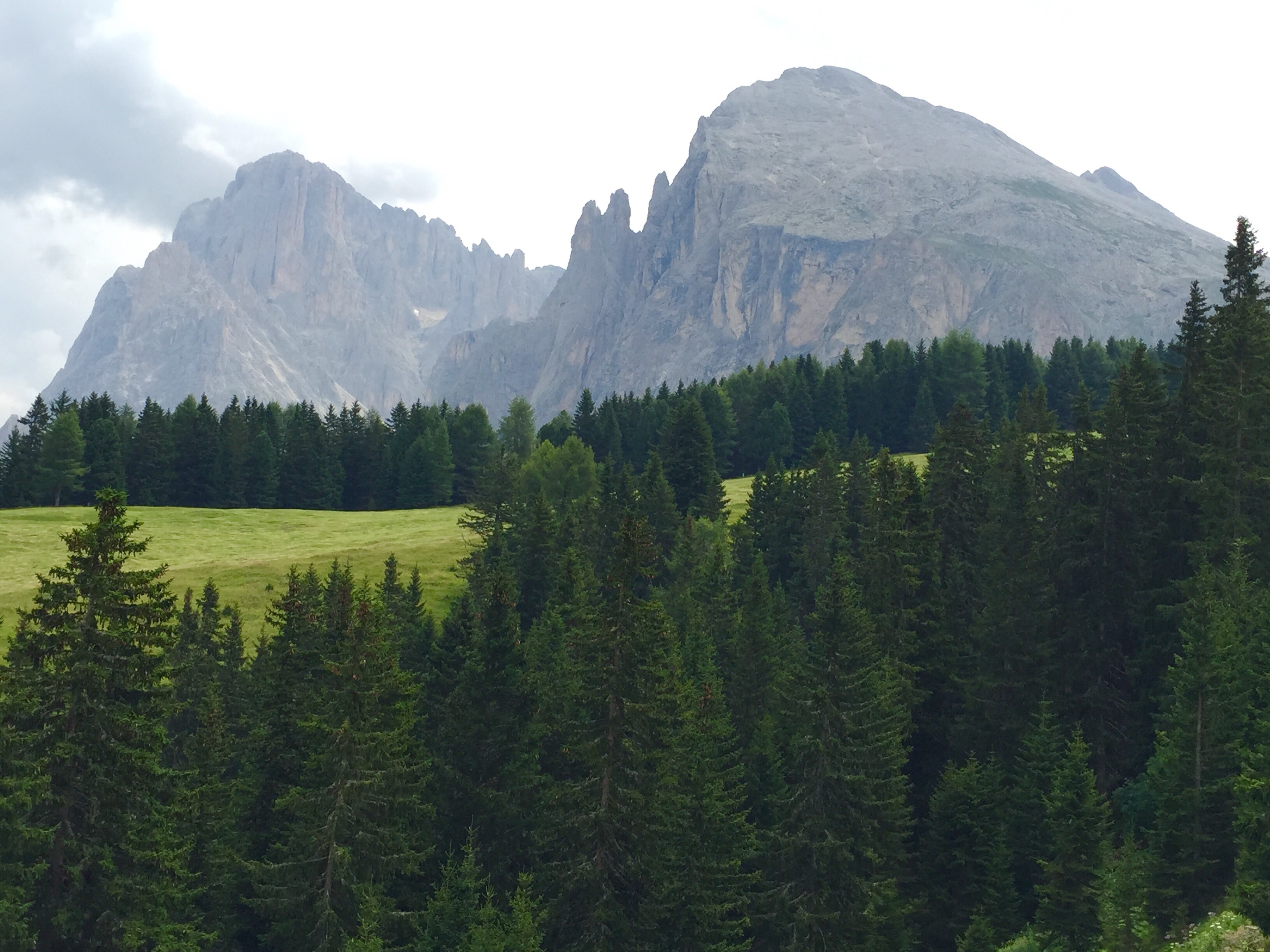
It’s a smooth rode up in a cable-lift blueberry to the highest Alpine meadow in Europe.The Dolomites are one of my favorite stops on our My Way Alpine tour. When we stay in the charming Italian Sudtirol village of Castellroto, the lift station that whisks us up to Seiser Alm/Alpe Di Siusi is just minutes away by bus. In our own little blueberry pod for four, we soar up, up, up and away until we reach 6500 ft—Europe’s highest alpine meadow.
Maxin’ and relaxin’ with a dynamite Dolomite view.
From here, ribbons of trails lead you on hikes of all skill levels (or you can just grab a lawn chair and gaze at the “whoa”-worthy views). I like to start a little bit higher by taking the ski lift from Compatch up to Panorama. It’s a glorious 3.5 hour trek to Zallinger, with lots of uphill/downhill changes that remind me of an EKG monitor (not only for the vertical variations but because of how hard my heart get pumping on that trail). Making friends and having a selfie moment in the Dolomites.Along the way, wildflowers abound, cows jingles their bells as you pass, and ponies (who have grown so accustomed to all the humans visiting their neck of the meadow) playfully nuzzle up to you for a selfie. And all the while, skyscraping peaks of Dolomite mountains formed millions of years ago stand guard all around you, and you feel both humbled by nature and emboldened by her.
When you make it to the mountain hut at the end of your expedition, relax a bit, have a drink, and celebrate your efforts. Tomorrow your muscles will probably let you know what they think about your sense of adventure, but tomorrow is another day.
Check out a few more images from my dynamite Dolomite hike on our recent My Way Alpine tour. Better still, come see Alpe di Siusi in person, and discover just how accessible these alpine wonders can be.
Come to the Dolomites and see what all the fun is about!
Earlier this year, my travels brought me to Nice. Since my first visit there 15 years ago, I have been under its delightful spell. And now, like so many, I am deeply saddened by the horrific act of terror inflicted on so many in this Riviera city on the 14th of July. And also like so many, I am *still* saddened by the tragedies in recent months and years in places like Turkey, Belgium, Syria, India, Iraq, Israel, Nigeria, Palestine, the United States, and so many other places that most of us never hear about.
But I won’t let the ruthless and cowardly acts of individuals with extreme, hateful, and violent beliefs turn me into someone filled with fear and mistrust. As travelers and as co-citizens of this planet, rather than shrink away, we can choose to engage with our world to try to understand it better and to share what we learn with our own communities when we come home.
So in the spirit of learning, understanding, healing, connection, and support, please enjoy some images of Nice that I took on my recent visit. Terrorism cannot take away the charm, beauty, and spirit of this city or its people. Nice is still nice, and hopefully, seeing these photos will remind you of your own memorable journeys to this Mediterranean jewel or will inspire you to go there soon.
Nice and the Baie des Anges (Bay of Angels) Place Masséna A bronze replica of The David catches everyone’s eye at the family-friendly public park Promenade du Paillon Hotel Negresco: a Nice icon since 1915. Marc Chagall donated a number of his Modernist creations to France to his eponymous museum, which opened in 1973. This Russian-French artist painted technicolor wonderlands, inspired by biblical events, peasant life, his Jewish heritage, and his wife. His works always seem to evoke a deep sense of love and respect for humanity, representing his subjects with the utmost dignity. Affectionately known as La Tête Carrée (Blockhead), this unusual piece of architecture actually houses Nice’s city library. The design, officially titled “Thinking I side the Box,” reminds us of the importance of seeking education, knowledge, and wisdom. In 2014, the Quai des États-Unis (the Quay of the United States) was renovated, and a replica of the Statue of Liberty was dedicated there to celebrate the friendship and unifying link between France and the U.S. The original “Statue of Liberty Enlightening the World” was gifted to America in 1886—100 years after the founding of the USA as an independent and sovereign nation—and remains a worldwide symbol of freedom and democracy. A mirror-like, walk-on-water feature called the Cours d’eau delights people day and night inside the Promenade du Paillon. Since the mid 1800s, The Promenade des Anglais (named for the English aristocracy who so often wintered in Nice) has been the place to see and be seen, to socialize, to be romantic, and to be wowed by the beauty of the Mediterranean. And even after the July 14th attack, The Prom (as locals call it) will still be a place to embrace and celebrate life, love, and community.
Not all travelers are created equal. Whether you’re a bold adventurer, culture vulture, foodie fanatic , history buff, or nature-lover, how you travel can be as important as why you travel and where you go. As an avid travel and tour guide, I know that incorporating our personal passions—and even our individual idiosyncrasies—into our travels makes our experiences more meaningful and memorable. And this month, I once again get to witness that first-hand.
Rick Steves wants to know: Are you gonna go My Way?
I’m on one of our Rick Steves’ Europe My Way Alpine tours. This time, I’m not the Tour Manager—Rick is ! It’s been nearly 20 years since he last led one of our tours, and he is still an amazing guide. While being his assistant on this tour will give me great opportunities to learn from “the master,” it’ll also give me a unique opportunity to be a fly-on-the-wall observer of the tour itself and, most interestingly to me, of our tour members and their My Way experiences.
On this tour, diversity seems to be a theme: we have a wide spectrum of ages, ethnicities and nationalities, professions, fitness levels, interests, and social engagement. There are couples and singles, young families and older families, grandparents, and adult siblings. During our Welcome Meeting, Rick asked everyone to share what they were most looking forward to on this European vacation. Although there were a few similar answers, most had specific sights, activities, or adventures that filled their individual travel dreams. Clearly, each traveler is seeking an experience that resonates with who they are, what they value, and what makes them tick.
For the next week or so, I’ll be sharing behind-the-scenes from our Rick Steves-led My Way Alpine tour. Join us as we criss-cross the rolling foothills and sky-scraping peaks of Austria, Italy, Germany, Switzerland, and France. You’ll discover just how exciting a trip through the Alps can be, and you’ll learn how you can enjoy your own travel adventures the My Way way.
28 different tour members, 28 different travel dreams. These wonderful folks are geared up and ready for their My Way Alpine adventure!
Unless today’s Sunday, it’s Market Day in Freiburg. As early as six in the morning, merchants and farmers from near and far descend upon the town, setting up their tents and stalls and artfully displaying their harvests and wares. As sleepy-eyed Freiburgers awake to a new day, the market begins to pulse with activity. ?It’s Market Day in Freiburg
Follow the cobblestone streets to the heart of the town. The tower spire of the cathedral (münster in German) is your beacon. You know you’re getting closer as the faint murmurs you hear grow into bustling chatter until finally, you reach the lively social nexus of Freiburg.
It’s been a similar experience for locals and travelers alike for 800 years in this town. Since the Middle Ages, people have congregated at the Münsterplatz (Cathedral Square) to chat with friends, to hear and share news about the neighbors down the street or from places well beyond the town’s walls, to gather their daily provisions, and to just to watch and be part of the scene.
A florist helps her customers to select just the right combination.Wandering from stall to stall, I take a few lingering moments to see what each vendor has to offer at today’s Münstermarkt. Produce is ubiquitous and flowers of all kinds are ready to be bundled into rainbows of bouquets. An olive-seller displays his shiny briny fruits like jewels and convinces me to sample the red pepper flakes and garlic medley (I end up buying 100 grams of it). There are wholesome baked goods, sticky marmalades, stinky cheeses, and exotic dried spices. Freiburg’s famous—and ridiculously long— red sausage can be found at half a dozen different stands boldly advertising lange Rote.
Just marble-ous
A bearded hipster has set up shop, hoping that someone will make use of his natural and handmade bristle brushes. A frizzy-haired woman tries to persuade customers that her vinegar infusions are great on everything. And if you think you’ve lost your marbles, the skinny fellow in glasses can sell you as many as you need.
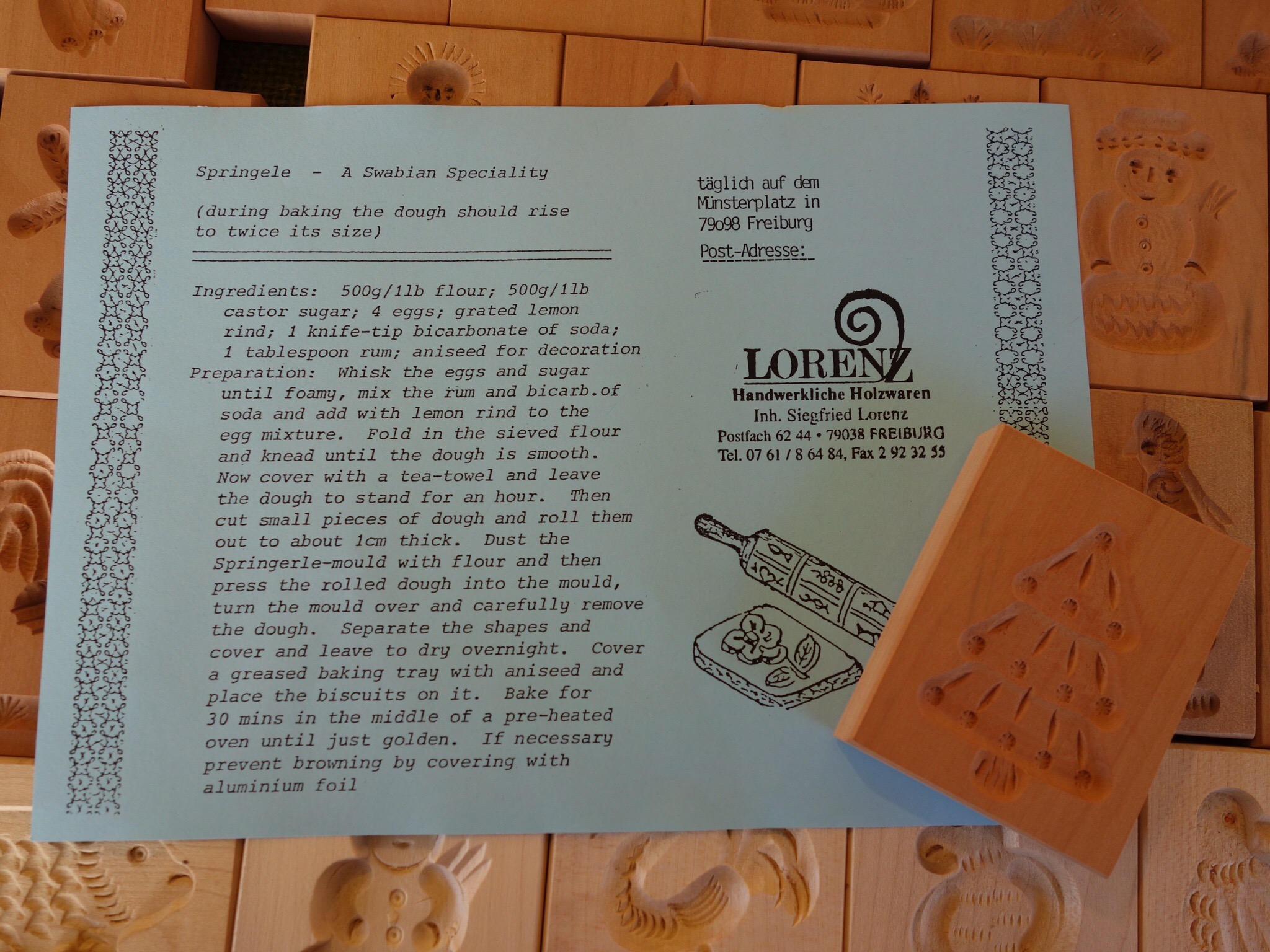
?Spingele cookie molds for saleTraditional Christmas cookiesA wall of hand-carved cookie molds catches my eye. The young merchant teaches me about the traditional Christmas biscuit Springele. In medieval times, they were often decorated with Biblical scenes. And while today there are still plenty of Christmasy designs, scenes of toys, animals, and everyday life are equally as common. In this area of Germany, people exchange the Springele like some exchange Christmas cards. The notion of this centuries-old tradition so touches me that I pick up a few molds for some friends and hope that they’ll blend some of this beautiful German culture into their own family traditions (get the Christmas biscuit recipe at the end of this article).
Be sure to check out the Freiburg City Museum’s Münsterplatz model
After filling my shopping bag with market goods, I stroll to the far end of the Münsterplatz to visit the City Museum. It’s humble and lacks posted English descriptions, but I find myself entranced by a top-floor exhibit. Encased in glass is a model of the very square I was just exploring. But this is set in the 13th-century, while the cathedral is midway through its construction. Thoughtfully detailed miniature figures populate the area around church.
Little builders work on the Freiburg cathedral.You can practically hear all the commotion: the fishmongers bark out the prices of their daily catch, a woman haggles over the price of bread, and tiny workers grumble about how much longer it’ll take to complete their town’s house of God. It’s a medieval slice of life, but it reminds me that even after eight centuries, daily life in Freiburg is delightfully still pretty much the same.Medieval life in miniatureIf you’re interested in sampling some Freiburg culture, here’s a recipe for Spingele that you might like to try.
One of my linguistics professors once said to me, “Language is culture.” He didn’t mean that it’s a part of one’s culture but that it both encompasses and permeates the culture. It defines—and is defined by— it. And whenever I travel, discovering the quirky phrases that make a culture tick helps me to get inside the mindsets of the people I meet and to see things from their point of view. Here are just a few encounters I had with culturally insightful expressions that I learned in one day of doing guidebook research in Baden-Baden.
After 5 non-stop hours of pounding the pavement, my brain was in dire need of caffeine, so I popped into a tiny bar-café. The barista and I were soon chatting like old friends. Her English was strong but she kept apologizing for not remembering how to say things. I told her, “Your English is much better than my German,” and she replied, “But my German is not as good as my Russian.”
Irina, the barista from Russia, teaches me some German.
Twenty years ago, Irina had left Russia for a better life in Germany and married a man from Baden-Baden, eventually giving birth to their daughter. Although grateful for the impressive education her child is receiving, with a distant look in her eyes, she told me it’s rare that she ever gets back to Russia. And aside from her husband and daughter, she has no family in Germany. The pain in her voice was heavy as memories seemed to well up in her eyes.
She thinks it’s tough for her daughter, too. “In German, we say zwieschen zwei Feuers. She is ‘between two flames’—her father and me.” Both are headstrong, both have their own ways, and their daughter gets caught in the middle. “I could write a book about what I’ve overcome because of moving to Germany. It’s so hard to be the constant outsider. I don’t know where I belong anymore.” I said in reply, “Maybe you’re zwieschen zwei Feuers, too. You could make that the title of your book.” She chuckled, “You know, I think you are right.”
Back on the job, I met the owner of new place I’d like to add to the Rick Steves’ Germany guidebook. David’s an expat from San Francisco doing his darnedest to get locals from Baden-Baden to eat healthier with fresh and hearty salads, couscous dishes, and generally lighter fare than the typical German diet. His clientele skews strongly big-city Germans and English-speaking visitors.
“Why do you think that is?” I wondered. He told me, “Germans from the city are more cosmopolitan, are exposed to a wider variety of cultures and cuisines, and are eager to try something different. English-speaking travelers just want a break from non-stop German food. They’ve had their fill of different. But here, the locals never get their fill of the same thing. They even have a saying: Was der Bauer nicht kennt, das frisst er nicht (What the farmer doesn’t know, the farmer doesn’t eat). I probably can’t win, but I’ll still keep trying to feed them healthy food.”
At dinner that night, my colleagues talked about everything under the sun, including Brexit, the Holocaust, regret, and Matt Damon (naturally). But some of my favorite moments were from the linguistic insights they shared about their respective cultures. Taylan (from Turkey) taught me about the magnificent concept off kahvalti. While you or I might call it breakfast, in Turkey, it really means “ the meal before coffee.” Turkish coffee is so important (and apparently so strong) that one does not drink it first thing in the morning. Instead, one has tea with the meal that precedes the real caffeine fix. (And here I thought that coffee was so important that it as my morning meal.)
L-R: Rick Steves’ Guides Torben, Taylan, Trish, and Heidebloem Driver Albert
Torben (from Germany) taught me that Germans have or will create a name for anything and everything. Everything is precise, everything is defined, and everything must have its place. Take for example Donaudampfschifffahrtsgesellschaftskapitanswitwe. Yes, that is one, singular, unhyphenated, long word, and it means “the widow of the Danube steamship company captain.” (That’s soooo German.) Now certainly not one of these expressions I learned is the Rosetta Stone that unlocks the secrets to another culture, but when you start to consider why someone says what they says and what’s the story behind the expression, you take one fun step closer to bridging cultural gaps when you travel.
What’s your favorite phrase? I’d love for you to share any catchy expressions you’ve learned while traveling or studying other languages. Or tell us an idiom from your own language that really give insight into the mindset of your culture. And remember to keep checking back here for more posts about my guidebook research discoveries and adventures in Germany, the exclusive look at the My Way Alpine tour with Rick, and the front-seat view of my two Best of Europe in 14 Days tours. Thanks for being my travel partner!
Confession time: I’m a last-minute packer, sometimes finishing up just hours before a flight. Fortunately, I pack so often that I’ve got my incomprehensible-to-most system down pat. On most trips, procrastination serves as stimulus to “get ‘er done.” Rare is it that something needed is forgotten at home. I get to the airport with sufficient time. And at worst, I’m the last to board with no more overhead cabin space, so my bag gets checked for free. #winning
Today, I miscalculated…big time. President Obama was arriving in Seattle, and I forgot to consider that when I summoned Uber just three hours before my international flight. What normally takes 40 minutes turned into a nearly two-hour creep down the I-5 freeway to SeaTac Airport. The Lufthansa desk agent said, with an all-too-cheery smile, “You had three minutes before we were going to close the check-in process, and the security line is really long today. You should probably get going right now!”
Walking as fast as my petite legs could manage, I bee-lined towards security. Out of the corner of my eye, a familiar face appeared. Sporting a turquoise SeaTac Volunteer polo shirt, my fellow Rick Steves’ tour guide, William, waved. We hugged quickly as I told him I was late for my flight. He replied, “Let’s see if I can escort you through. It doesn’t hurt to try.” What I heard was, “I’ll save the day!” and I could swear that his teeth sparkled as he stood Superman-style with his arms on his hips…(or was his arm just bent that way because he was holding a clipboard?)
Minutes later, I was suddenly at the security desk—all thanks to my Airport Angel. After a quick selfie, I made it through security and was the third to last person to board my flight to Frankfurt. Phew!
SeaTac Volunteer William to the rescue!
Approaching my middle seat, I realized I’d be sandwiched between a burly German and man in flowing saffron robes. The robed one’s eyes were closed, and he looked so peaceful; I hated to disturb him. When I tapped his shoulder, his eyes fluttered, he smiled benevolently, and gestured for me to take the seat next to him. Awkwardly, I climbed over the Tibetan monk and shimmied into my seat. Too shy to say anything (and not knowing what I would say to him anyways), I silently thought: This is as close to the Dalai Lama as I’ll ever be.
Mid-flight, I noticed the monk repeatedly glancing at my screen. I flinched because Fargo is probably not the best airplane movie to watch when sitting next to a spiritual being, but it occurred to me that he wasn’t bothered by what I was watching. He just wanted to use his screen, too, but didn’t know how.
Through broken English, miming, and lots of pointing at his screen, I deciphered his wish to listen to music. I helped him scroll through the long list of albums but had no clue what he’d like to hear. Trial and error taught me that he disliked German classical music, was lukewarm to Motown, but really enjoyed Demi Lovato and Jon Bon Jovi. (And honestly, who doesn’t?)
Eventually we discovered a common language: French. After that, we learned a lot about one another. We found out where each other was born (I in California, he in Tibet) and where we now live (he in Reims, France and I in Seattle). I discovered that he had been in Seattle for two months to care for an ailing friend and that the friend had just passed away a few days ago. He learned that I love cheese, and I realized he had a sweet tooth. And we taught one another our names, taking turns writing them out in my Rick Steves’ Germany guidebook.
One of my best souvenirs of all time: the writings of a Tibetan monk in my guidebook.
After finally introducing ourselves formally, I turned to him to shake his hand and said, “Enchantée” (“Delighted to meet you” in French). He giggled, took my hand, and pressed the back of it to his cheek. I almost shed a tear.
For the rest of the flight, we alternated between dozing (he’s perfectly still when he sleeps), cleaning up after one another (he took care of my trash and gave it to the flight attendants, and I wiped up his spilt sugar and spilt tea—he was charmingly clumsy). We smiled and laughed a lot together. And we tinkered quite a bit with his video screen. Eventually he settled on watching the flight path. He told me even looking at a fake blue ocean can be almost as beautiful as the real thing.
When we arrived at our gate in Frankfurt, we took a selfie and then exited the plane together. He would take a 3-hour bus to Reims, and I would connect to Basel and then bus it to Freiburg. At the end of the corridor, we came to a wheelchair that had his name on it: Kenpo Dakpa Woeser (I later discovered that “Kenpo” means “Learned One”). Rather than be sad about our parting, I felt so lifted by our 9-hour encounter, and I knew in my heart that I would always remember this flight to Germany.
I know I’ll never see this monk again, but the impact he made on me will remain one of my fondest travel memories.
I wished him a good journey to Reims. He took both of my hands into his and gently touched his forehead to mine. I don’t know the traditional significance of this Tibetan way of saying goodbye, but I do know that I felt wholly blessed to meet this gentle soul.
It’s funny but travel can open up a person to so many blessings in unexpected ways. Whether it’s getting help from a friend or stranger when you need it most, helping someone else who might feel more culturally lost than you, or creating a beautiful friendship (no matter how short-lived it might be), travel takes you not only beyond where you were but beyond who you were.
Join me over the next couple of months as I continue blogging in Europe. Learn the ins and outs of guidebook research as I journey through Freiburg, Baden-Baden, Rothenburg, and Nürnberg to update Rick Steves’ Germany. Discover what it’s like to have Rick Steves as your Tour Manager when I join him as his assistant on the My Way Alps tour. Be my travel partner as I explore Saint-Émilion and Bordeaux for the first time during my “vacation.” And get a front-row seat on my tour bus as I lead two back-to-back Rick Steves’ Best of Europe in 14 Days tours.